Saturday, 10 February 2018

How to Balance Chemical Equations

How to Balance Chemical Equations


A chemical equation is a written symbolic representation of a chemical reaction. The reactant chemical(s) are given on the left-hand side and the product chemical(s) on the right-hand side. The two are connected with an arrow leading from the left to the right, symbolizing the reaction. The law of conservation of mass states that no atoms can be created or destroyed in a chemical reaction, so the number of atoms that are present in the reactants has to balance the number of atoms that are present in the products. Follow this guide to learn how to balance chemical equations differently.
Write down your given equation. For this example, you will use:
  • C3H8 + O2 --> H2O + CO2
  • This reaction occurs when propane (C3H8) is burned in the presence of oxygen to produce water and carbon dioxide.
  • Image titled Balance Chemical Equations Step 2
Write down the number of atoms per each element that you have on each side of the equation. Look at the subscripts next to each atom to find the number of atoms in the equation.
  • Left side: 3 carbon, 8 hydrogen and 2 oxygen.
  • Right side: 1 carbon, 2 hydrogen and 3 oxygen.Image titled Balance Chemical Equations Step 3
Always leave hydrogen and oxygen for last.
Image titled Balance Chemical Equations Step 4

If you have more than one element left to balance: select the element that appears in only a single molecule of reactants and in only a single molecule of products. This means that you will need to balance the carbon atoms first.
Image titled Balance Chemical Equations Step 5

Add a coefficient to the single carbon atom on the right of the equation to balance it with the 3 carbon atoms on the left of the equation.
  • C3H8 + O2 --> H2O + 3CO2
  • The coefficient 3 in front of carbon on the right side indicates 3 carbon atoms just as the subscript 3 on the left side indicates 3 carbon atoms.
  • In a chemical equation, you can change coefficients, but you must never alter the subscripts.
  • Image titled Balance Chemical Equations Step 6    
Balance the hydrogen atoms next. You have 8 on the left side. So you'll need 8 on the right side.
  • C3H8 + O2 --> 4H2O + 3CO2
  • On the right side, you now added a 4 as the coefficient because the subscript showed that you already had 2 hydrogen atoms.
  • When you multiply the coefficient 4 times by the subscript 2, you end up with 8.
  • The other 6 atoms of Oxygen come from 3CO2.(3x2=6 atoms of oxygen+ the other 4=10)
  • Image titled Balance Chemical Equations Step 7 

Balance the oxygen atoms.
  • Because you've added coefficients to the molecules on the right side of the equation, the number of oxygen atoms has changed. You now have 4 oxygen atoms in the water molecules and 6 oxygen atoms in the carbon dioxide molecules. That makes a total of 10 oxygen atoms.
  • Add a coefficient of 5 to the oxygen molecule on the left side of the equation. You now have 10 oxygen atoms on each side.
  • C3H8 + 5O2 --> 4H2O + 3CO2.


Chemical Equation vs Chemical Reaction

Chemical Equation vs Chemical Reaction


A chemical equation is a written representation of the process that occurs in a chemical reaction. A chemical equation is written with the reactants on the left side of an arrow and the products of the chemical reaction on the right side of the equation.
The head of the arrow typically points toward the right or toward the product side of the equation, although reactions may indicate equilibrium with the reaction proceeding in both directions simultaneously.
The elements in an equation are denoted using their symbols. Coefficients next to the symbols indicate the stoichiometric numbers. Subscripts are used to indicate the number of atoms of an element present in a chemical species.
An example of a chemical equation may be seen in the combustion of methane:
CH4 + 2 O2 → CO2 + 2 H2O
Participants in the Chemical Reaction: Element Symbols
You'll need to know the symbols for the elements to understand what is taking place in a chemical reaction. In this reaction, C is carbon, H is hydrogen and O is oxygen.
Left Side of Reaction: Reactants
The reactants in this chemical reaction are methane and oxygen: CH4 and O2.
Right Side of Reaction: Products
The products of this reaction are carbon dioxide and water: CO2 and H2O.
Direction of Reaction: Arrow
It is the convention to right the reactants on the lefthand side of the chemical equation and the products on the righthand side of the chemical equation. The arrow between the reactants and products should point from left to right or should point both directions if the reaction is proceeding both ways (this is common).
If your arrow points from right to left, it's a good idea to re-write the equation the conventional way.

Learn about electric circuits


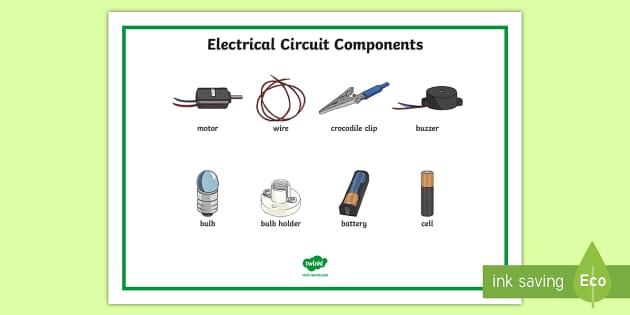
Image result for components of electric circuit

Image result for components of electric circuit

Learn about electric circuits


Image result for components of electric circuit


How do electric circuits work?

How do electric circuits work?


                 An electric circuit is like a pathway made of wires that electrons can flow through. A battery or other power source gives the force (voltage) that makes the electrons move. When the electrons get to a device like a light bulb, your computer, or a refrigerator, they give it the power to make it work.
The word “circuit” sounds like “circle,” and a circuit needs to be circular to work. The wires have to go from the power source to the device and back again, so that the electrons can go out and come back.
Many circuits have a switch so that they can be turned on and off. When the switch is off, it makes a gap in the circuit and the electrons are not able to flow around. When the switch is turned on, it closes the gap and the electricity is able to move and make the device work.

Image result for components of electric circuit


To make a electric circuit

How to make a simple electric circuit?


         1.Gather the necessary materials. To build a simple circuit, you will need a power                source, two insulated wires, a light bulb, and a light bulb holder. A power source can              be any type of battery or battery pack. The rest of the materials can be found at your            local hardware store.When choosing a light bulb, keep in mind the amount of power              your battery emits.To simplify the wire attachment process, use a battery snap with                wires pre-attached and a nine volt battery or battery pack.                                 
   2. Strip the ends of the insulated wires. In order for your circuit to work properly, the wires need to be totally exposed so you must strip the ends. Using wire strippers, remove about an inch of the insulation from the ends of each wire.If you don’t have wire strippers, you can carefully use scissors to cut off the insulation.Be careful not to cut all the way through the wire.                                                                                            3.Install batteries into battery pack. Depending on the type of batteries you are using, you may be able to skip this step. If you are using multiple batteries, you will need a power pack to hold the batteries. Push each battery in by the side taking care to put the positive and negative ends in the correct orientation.                                          4. Attach your wires to the battery pack. The wires will be conducting your electric current from the batteries to the light bulb. The easiest way to attach the wires is to use electrical tape. Attach the end of one wire to one side of the battery, making sure that the wire maintains contact with the metal of the battery. Repeat with the other wire on the other side of the battery.Alternatively, if you are using a battery snap, snap the end onto the end of a nine volt battery or the battery pack.Use caution while building your circuit. Although unlikely, it is possible to get a very small shock if you touch the wire directly while attached to the battery. You can avoid this by only touching the insulated part of the wire or removing the batteries until you install the light bulb.                                                                                                 
     5.Test your circuit. Screw the light bulb into its holder until it is tight. If your circuit is hooked up properly, the bulb should light up when fully screwed into its socket.Light bulbs can heat up quickly so be careful when installing and removing the bulb.If the bulb doesn’t light, check to make sure the wires are touching the ends of the battery and in contact with the metal of the screws.