Saturday, 10 February 2018

How to Balance Chemical Equations

How to Balance Chemical Equations


A chemical equation is a written symbolic representation of a chemical reaction. The reactant chemical(s) are given on the left-hand side and the product chemical(s) on the right-hand side. The two are connected with an arrow leading from the left to the right, symbolizing the reaction. The law of conservation of mass states that no atoms can be created or destroyed in a chemical reaction, so the number of atoms that are present in the reactants has to balance the number of atoms that are present in the products. Follow this guide to learn how to balance chemical equations differently.
Write down your given equation. For this example, you will use:
  • C3H8 + O2 --> H2O + CO2
  • This reaction occurs when propane (C3H8) is burned in the presence of oxygen to produce water and carbon dioxide.
  • Image titled Balance Chemical Equations Step 2
Write down the number of atoms per each element that you have on each side of the equation. Look at the subscripts next to each atom to find the number of atoms in the equation.
  • Left side: 3 carbon, 8 hydrogen and 2 oxygen.
  • Right side: 1 carbon, 2 hydrogen and 3 oxygen.Image titled Balance Chemical Equations Step 3
Always leave hydrogen and oxygen for last.
Image titled Balance Chemical Equations Step 4

If you have more than one element left to balance: select the element that appears in only a single molecule of reactants and in only a single molecule of products. This means that you will need to balance the carbon atoms first.
Image titled Balance Chemical Equations Step 5

Add a coefficient to the single carbon atom on the right of the equation to balance it with the 3 carbon atoms on the left of the equation.
  • C3H8 + O2 --> H2O + 3CO2
  • The coefficient 3 in front of carbon on the right side indicates 3 carbon atoms just as the subscript 3 on the left side indicates 3 carbon atoms.
  • In a chemical equation, you can change coefficients, but you must never alter the subscripts.
  • Image titled Balance Chemical Equations Step 6    
Balance the hydrogen atoms next. You have 8 on the left side. So you'll need 8 on the right side.
  • C3H8 + O2 --> 4H2O + 3CO2
  • On the right side, you now added a 4 as the coefficient because the subscript showed that you already had 2 hydrogen atoms.
  • When you multiply the coefficient 4 times by the subscript 2, you end up with 8.
  • The other 6 atoms of Oxygen come from 3CO2.(3x2=6 atoms of oxygen+ the other 4=10)
  • Image titled Balance Chemical Equations Step 7 

Balance the oxygen atoms.
  • Because you've added coefficients to the molecules on the right side of the equation, the number of oxygen atoms has changed. You now have 4 oxygen atoms in the water molecules and 6 oxygen atoms in the carbon dioxide molecules. That makes a total of 10 oxygen atoms.
  • Add a coefficient of 5 to the oxygen molecule on the left side of the equation. You now have 10 oxygen atoms on each side.
  • C3H8 + 5O2 --> 4H2O + 3CO2.


Chemical Equation vs Chemical Reaction

Chemical Equation vs Chemical Reaction


A chemical equation is a written representation of the process that occurs in a chemical reaction. A chemical equation is written with the reactants on the left side of an arrow and the products of the chemical reaction on the right side of the equation.
The head of the arrow typically points toward the right or toward the product side of the equation, although reactions may indicate equilibrium with the reaction proceeding in both directions simultaneously.
The elements in an equation are denoted using their symbols. Coefficients next to the symbols indicate the stoichiometric numbers. Subscripts are used to indicate the number of atoms of an element present in a chemical species.
An example of a chemical equation may be seen in the combustion of methane:
CH4 + 2 O2 → CO2 + 2 H2O
Participants in the Chemical Reaction: Element Symbols
You'll need to know the symbols for the elements to understand what is taking place in a chemical reaction. In this reaction, C is carbon, H is hydrogen and O is oxygen.
Left Side of Reaction: Reactants
The reactants in this chemical reaction are methane and oxygen: CH4 and O2.
Right Side of Reaction: Products
The products of this reaction are carbon dioxide and water: CO2 and H2O.
Direction of Reaction: Arrow
It is the convention to right the reactants on the lefthand side of the chemical equation and the products on the righthand side of the chemical equation. The arrow between the reactants and products should point from left to right or should point both directions if the reaction is proceeding both ways (this is common).
If your arrow points from right to left, it's a good idea to re-write the equation the conventional way.

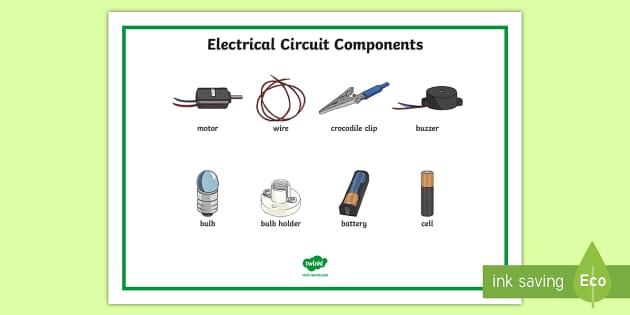
Learn about electric circuits


Image result for components of electric circuit

Image result for components of electric circuit

Learn about electric circuits


Image result for components of electric circuit


How do electric circuits work?

How do electric circuits work?


                 An electric circuit is like a pathway made of wires that electrons can flow through. A battery or other power source gives the force (voltage) that makes the electrons move. When the electrons get to a device like a light bulb, your computer, or a refrigerator, they give it the power to make it work.
The word “circuit” sounds like “circle,” and a circuit needs to be circular to work. The wires have to go from the power source to the device and back again, so that the electrons can go out and come back.
Many circuits have a switch so that they can be turned on and off. When the switch is off, it makes a gap in the circuit and the electrons are not able to flow around. When the switch is turned on, it closes the gap and the electricity is able to move and make the device work.

Image result for components of electric circuit


To make a electric circuit

How to make a simple electric circuit?


         1.Gather the necessary materials. To build a simple circuit, you will need a power                source, two insulated wires, a light bulb, and a light bulb holder. A power source can              be any type of battery or battery pack. The rest of the materials can be found at your            local hardware store.When choosing a light bulb, keep in mind the amount of power              your battery emits.To simplify the wire attachment process, use a battery snap with                wires pre-attached and a nine volt battery or battery pack.                                 
   2. Strip the ends of the insulated wires. In order for your circuit to work properly, the wires need to be totally exposed so you must strip the ends. Using wire strippers, remove about an inch of the insulation from the ends of each wire.If you don’t have wire strippers, you can carefully use scissors to cut off the insulation.Be careful not to cut all the way through the wire.                                                                                            3.Install batteries into battery pack. Depending on the type of batteries you are using, you may be able to skip this step. If you are using multiple batteries, you will need a power pack to hold the batteries. Push each battery in by the side taking care to put the positive and negative ends in the correct orientation.                                          4. Attach your wires to the battery pack. The wires will be conducting your electric current from the batteries to the light bulb. The easiest way to attach the wires is to use electrical tape. Attach the end of one wire to one side of the battery, making sure that the wire maintains contact with the metal of the battery. Repeat with the other wire on the other side of the battery.Alternatively, if you are using a battery snap, snap the end onto the end of a nine volt battery or the battery pack.Use caution while building your circuit. Although unlikely, it is possible to get a very small shock if you touch the wire directly while attached to the battery. You can avoid this by only touching the insulated part of the wire or removing the batteries until you install the light bulb.                                                                                                 
     5.Test your circuit. Screw the light bulb into its holder until it is tight. If your circuit is hooked up properly, the bulb should light up when fully screwed into its socket.Light bulbs can heat up quickly so be careful when installing and removing the bulb.If the bulb doesn’t light, check to make sure the wires are touching the ends of the battery and in contact with the metal of the screws.

Saturday, 13 January 2018

Chemical reaction

Chemical reaction
     Chemical reaction, a process in which one or more substances, the reactants, are converted to one or more different substances, the products. Substances are either chemical elements or compounds. A chemical reaction rearranges the constituent atoms of the reactants to create different substances as products.
            A Chemical Reaction is a process that occurs when two or more molecules interact to form a new product(s). Compounds that interact to produce new compounds are called reactants whereas the newly formed compounds are called products. Chemical reactions play an integral role in different industries, customs and even in our daily life. They are continuously happening in our general surroundings; for example, rusting of iron, pottery, fermentation of wine and so on.
           In a chemical reaction, a chemical change must occur which is generally observed with physical changes like precipitation, heat production, color change etc. A reaction can take place between two atoms or ions or molecules and they form a new bond and no atom is destroyed or created but a new product is formed from reactants. The rate of reaction depends on and is affected by factors like pressure, temperature, the concentration of reactants.
Let us consider an actual chemical reaction between Methane(CH₄) and Oxygen (O2),
Chemical Reactions

What is the Fifth State of Matter?

What is the Fifth State of Matter?


The fifth state of matter is actually the first phase of matter. It is called a Bose-Einstein Condensate. Matter in the fifth state is really slow moving and extremely condensed. It only exists at near absolute zero temperatures and is very fragile and unstable. It was discovered in 1995 by Eric Cornell and Carl Weiman through experimentation with rubidium, but the credit goes to Satyendra Nath Bose and Albert Einstein because they thought of the concept of this state of matter first. The only difference is that they did not have the tools available to make it possible to observe the fifth state of matter in the 1920's.

There are a number of elements which have been created into great examples of Bose-Einstein Condensates. They take different amounts of energy to produce the condensate of each element, but they each react in a similar manner. The following are great elements to use for Bose-Einstein Condensates:
  • Lithium – Abbreviated to Li and atomic number 3, Silver White Alkali Metal
  • Sodium – Abbreviated to Na and atomic number 11, Silvery White Highly Reactive Alkali Metal
  • Potassium – Abbreviated to K and atomic number 19, Silvery White Alkali Metal
  • Chromium – Abbreviated to Cr and atomic number 24, Lustrous Steel-Gray Metal
  • Strontium – Abbreviated to Sr and atomic number 38, Yellowish Silver Alkaline Earth Metal
  • Rubidium – Abbreviated to Rb and atomic number 37, Silvery While Alkali Metal
  • Cesium – Abbreviated to Cs and atomic number 55, Silvery Gold Alkali Metal
  • Ytterbium – Abbreviated to Yb and atomic number 70, Silvery White Metal

States of Matter

States of Matter


Image result for state of matter
Microscopic view of  solid, liquid and gas
    
Microscopic view of a solid.
Microscopic view of a liquid.
Microscopic view of a gas

Plasma - The fourth state of Matter

Plasma - The fourth state of matter

   A plasma is a hot ionized gas consisting of approximately equal numbers of positively charged ions and negatively charged electrons. The characteristics of plasmas are significantly different from those of ordinary neutral gases so that plasmas are considered a distinct "fourth state of matter." For example, because plasmas are made up of electrically charged particles, they are strongly influenced by electric and magnetic fields  while neutral gases are not. An example of such influence is the trapping of energetic charged particles along geomagnetic field lines to form the Van Allen radiation belts.
Image result for plasma state of matter
In addition to externally imposed fields, such as the Earth's magnetic field or the interplanetary magnetic field, the plasma is acted upon by electric and magnetic fields created within the plasma itself through localized charge concentrations and electric currents that result from the differential motion of the ions and electrons. The forces exerted by these fields on the charged particles that make up the plasma act over long distances and impart to the particles' behavior a coherent, collective quality that neutral gases do not display. (Despite the existence of localized charge concentrations and electric potentials, a plasma is electrically "quasi-neutral," because, in aggregate, there are approximately equal numbers of positively and negatively charged particles distributed so that their charges cancel.) 

Fun Facts about Electricity:

Fun Facts about Electricity:
  • Electricity travels at the speed of light - more than 186,000 miles per second!
  • A spark of static electricity can measure up to three thousand (3,000) volts.
  • A bolt of lightning can measure up to three million (3,000,000) volts, and it lasts less than one second!
  • Electricity always tries to find the easiest path to the ground.
  • Electricity can be made from wind, water, the sun and even animal poop.
  • A 600 megawatt natural gas plant can power 220,000 homes.
  • The first power plant - owned by Thomas Edison - opened in New York City in 1882.
  • Thomas Edison invented more than 2,000 new products, including almost everything needed for us to use electricity in our homes: switches, fuses, sockets and meters.
  • Benjamin Franklin didn't discover electricity, but he did prove that lightning is a form of electrical energy.

Friday, 12 January 2018

Effect of science of human life

Effect of science of human life:
 It is, indeed, true that science has added tremendously to the comforts and conveniences of mankind. Unless one is an ascetic, one has no reason to reject the things science offers. By conquering time and distance science has brought mankind together and so far made life richer. By inventing medicines it has made our day-to-day existence relatively free from disease, and has, indeed, added to our length of life.
Examples of use of Science in everyday life: This fan and light works from the application of electricity. Electricity is one of the wonders of modern science. The bus which has an engine works with petroleum. The train is driven by the power of coal. This is possible only because of the application of science. My doctor gives certain injections and the patient soon well enough to come here. Medical science is another achievement of modern science, the marvel of medicine.
From the above, it is clear that science is playing an important part in our everyday life.

Physics and Mathematics

 Physics and Mathematics
As a whole, physics is closely related to mathematics, for it provides the logical structure in which physical laws may be formulated and their predictions quantified. A great many of physics' definitions, models, and theories are expressed using mathematical symbols and formulas.
The central difference between physics and mathematics is that ultimately physics is concerned with descriptions of the material world whereas mathematics is focused on abstract logical patterns that may extend beyond the real world.
Because physics concentrates on the material world, it tests its theories through the process known as observation or experimentation. In theory, it may seem relatively easier to detect where physics leaves off and mathematics picks up. However, in reality, such a clean-cut distinction does not always exist. Hence, the gray areas in between physics and mathematics tend be called "mathematical physics."
Both engineering and technology also have ties to physics. For instance, electrical engineering studies the practical application of electromagnetism. That is why you will quite often find physics to be a component in the building of bridges, or in the creation of electronic equipment, nuclear weaponry, lasers, barometers, and other valuable measurement devices.

Physics. Definition

Physics. Definition
When learning about and discussing physics, we focus heavily on energy, the core element of the science. To better understand this connection, it helps to refer to a solid working definition of physics.
Physics. The science in which matter and energy are studied both separately and in combination with one another.
And a more detailed working definition of physics may be: The science of nature, or that which pertains to natural objects, which deals with the laws and properties of matter and the forces which act upon them. Quite often, physics concentrates upon the forces having an impact upon matter, that is, gravitationheatlightmagnetismelectricity, and others.

Physics. Range of Fields

Physics. Range of Fields

While there are no definitive answers as to whether or not physics is more complex than other sciences, it is safe to say that physics has decidedly more branches, both traditional and modern.
Take for example the range of traditional subdivisions of physics that exist: acoustics, optics, mechanics, thermodynamics, and electromagnetism. And then there are those still considered to be modern extensions: atomic and nuclear physics, cryogenics, solid-state physics, particle physics, and plasma physics.
Below is a list, by no means comprehensive, of the dizzying variety of disciplines that exist within the science of physics:

  • Acoustics. Study of sound and sound waves.
  • Astronomy. Study of space.
  • Astrophysics. Study of the physical properties of objects in space.
  • Atomic Physics. Study of atoms, specifically the electron properties of the atom.
  • Biophysics. Study of physics in living systems.
  • Chaos. Study of systems with strong sensitivity to initial conditions, so that a slight change at the beginning quickly becomes major changes in the system.
  • Chemical Physics. Study of physics in chemical systems.
  • Computational Physics. Application of numerical methods to solve physical problems for which a quantitative theory already exists.
  • Cosmology. Study of the universe as a whole, including its origins and evolution.
  • Cryophysics, Cryogenics, and Low Temperature Physics. Study of physical properties in low temperature situations, far below the freezing point of water.
  • Crystallography. Study of crystals and crystalline structures.
  • Electromagnetism. Study of electrical and magnetic fields, which are two aspects of the same phenomenon.
  • Electronics. Study of the flow of electrons, generally in a circuit.
  • Fluid Dynamics and Fluid Mechanics. Study of the physical properties of "fluids," specifically defined in this case to be liquids and gases.
  • Geophysics. Study of the physical properties of the Earth.
  • High Energy Physics. Study of physics in extremely high energy systems, generally within particle physics.
  • High Pressure Physics. Study of physics in extremely high pressure systems, generally related to fluid dynamics.
  • Laser Physics. Study of the physical properties of lasers.
  • Mathematical Physics. Discipline in which rigorous mathematical methods are applied to solving problems related to physics.
  • Mechanics. Study of the motion of bodies in a frame of reference.
  • Meteorology and Weather Physics. Physics of weather.
  • Molecular Physics. Study of physical properties of molecules.
  • Nanotechnology. Science of building circuits and machines from single molecules and atoms.
  • Nuclear Physics. Study of the physical properties of the atomic nucleus.
  • Optics and Light Physics. Study of the physical properties of light.
  • Particle Physics. Study of fundamental particles and the forces of their interaction.
  • Plasma Physics. Study of matter in the plasma phase.
  • Quantum Electrodynamics. Study of how electrons and photons interact at the quantum mechanical level.
  • Quantum Mechanics and Quantum Physics. Study of science where the smallest discrete values, or quanta, of matter and energy become relevant.
  • Quantum Optics. Application of quantum physics to light.
  • Quantum Field Theory. Application of quantum physics to fields, including the fundamental forces of the universe.
  • Quantum Gravity. Application of quantum physics to gravity and the unification of gravity with the other fundamental particle interactions.
  • Relativity. Study of systems displaying the properties of Einstein's theory of relativity, which generally involves moving at speeds very close to the speed of light.
  • Statistical Mechanics. Study of large systems by statistically expanding the knowledge of smaller systems.
  • String Theory and Superstring Theory. Study of the theory that all fundamental particles are vibrations of one-dimensional strings of energy, in a higher-dimensional universe.
  • Thermodynamics. Physics of heat.

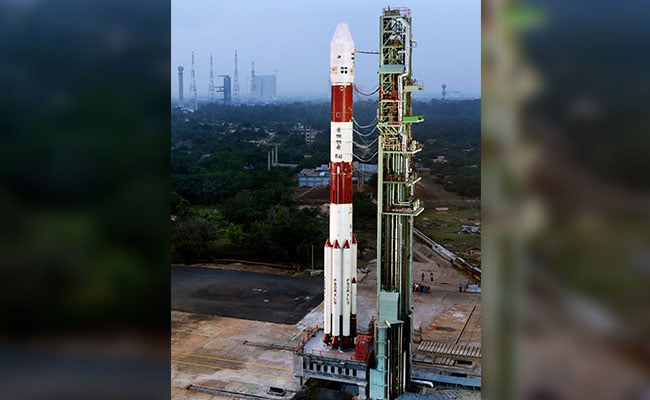
ISRO s 100th satellite

ISRO 100th Satellite Launch Live Updates: ISRO Successfully Lifts Off PSLV-C40 From Sriharikota


SRIHARIKOTA:  The Polar Satellite Launch Vehicle or PSLV lifts off today from Sriharikota in Andhra Pradesh. The PSLV carries 31 satellites in total from countries including India and six other countries. Cartosat 2 -- a surveillance satellite that was part of India's 100th satellite was placed into sun synchronous orbit according to ISRO. The satellites are to be launched in two orbits which makes the mission a unique one according to scientists. The entire lift-off process along with the process of placing the satellites in two orbits is to take the satellite 2 hours and 21 minutes. 
ISRO 100th Satellite Launch Live Updates: ISRO Successfully Lifts Off PSLV-C40 From Sriharikota